


Inside Out: The Discipline of Feeling

Daily writing prompt
When are you most happy?

Pixar’s Inside Out is often praised for making emotions legible, by color-coding them, naming them, and placing them neatly at their respective spots at a control panel. While it may be easy to watch the movie and believe its message is the value of emotional mastery, this surface clarity reveals a more unsettling argument. Inside Out attempts instead to reveal the value of emotional tolerance. Its deepest claim is not that happiness comes from managing feelings well, but that constant contradiction of emotion is necessary to create identity.

I. Continuity

Joy begins the film as the keeper of continuity. She treats Riley’s inner life as something to be curated, and protected from contamination. Sadness, in her view, corrodes life. If sadness touches a memory, the memory changes, so Joy fears this potential narrative fracture. However, this fear is prevalent in modern culture. We believe happiness to be stability; we believe it to be a consistent mood, a smooth trajectory. Self-help language also reinforces this fantasy by encouraging us to “protect our peace” as though peace were a fragile artifact rather than a dynamic process. At the beginning of the movie, Joy embodies this impulse, believing that if the right emotions remain in charge, the self will remain intact.

II. Sadness

But Inside Out dismantles this belief. When Sadness touches Riley’s memories, they don’t crack or fracture; rather, they deepen. Riley’s joyful recollections of childhood play become tinged with grief, but not because the joy was false; that grief comes from the memories belonging to a time that cannot be recovered, something we have all experienced. The memory gains depth and complexity, and with that comes narrative truth. What Joy interprets as damage is really just maturation.

The film suggests that unpleasant emotions like sadness are necessary to complete meaning. Only through sadness can experience remain emotionally legible over time. Without it, memories become artifacts, forever frozen, incapable of accommodating change. Riley’s crisis emerges when her emotional system can no longer pretend that continuity is possible. Moving cities disrupt her internal story. Her old sources of meaning, her friends, routines, and landscapes, shift apart. And the attempt to remain cheerful under these conditions produces emotional turmoil.

III. Growing

The ultimate resolution to this crisis is not the restoration of Joy’s authority, but a deeper understanding of the emotional hierarchy. When Sadness is allowed to speak, Riley’s pain becomes shareable. The problem isn’t solved, but her parents can help because the problem has been named.

In this sense, Inside Out offers a corrective view to a culture obsessed with emotional optimization. It suggests that unlike popular belief, psychological health is not achieved by minimizing negative states, but by allowing them to rise up to construct meaning. The film implies that identity is a dynamic system that must remain open to revision.

IV. Conclusion

The film ends with memories that shimmer with multiple emotional hues, refusing closure. Riley’s inner life becomes more difficult to map out, but it becomes more real. Every emotion evolves together. If Inside Out has a lesson, it is not that sadness is good, or that joy is naive. The lesson lies in the fact that a self that insists on feeling only one thing at a time will eventually lose the ability to feel anything honestly at all. Emotional maturity, like narrative truth, requires the courage to let experiences change us. Even if it’s hard. Even if it disrupts the story we carry of ourselves. Because to live is to keep becoming, again and again.
Frames of Identity

Hurca! - Stock Adobe
Daily writing prompt
What’s the first impression you want to give people?
Hurca! - Stock Adobe
The first impression you give someone feels simple.

A glance, a phrase, the slight tilt of your voice as it tries to decide whether to sound confident or careful. But beneath that moment sits a truth most people never notice. It may be easy forget that others never gain awareness of the full architecture you are. Rather, a moment of awareness is simply one frame in a long sequence, and your brain rushes to stitch these frames together so you can believe there is a solid self living behind your eyes.

Identity is not what we think. I understand it as a continuity the brain desperately creates from separate moments to make sense of the movement of our lives. Neuroscientist Anil Seth calls this a controlled hallucination. The mind fills the gaps so you do not feel the gaps. It connects the flicker of one second to another until the whole thing seems unbroken, like a film reel running just fast enough to appear real.

We like to believe we are consistent people. Yet the research on memory says otherwise. We are creatures of reconstruction. Every remembered version of yourself is edited, packaged for memory, and rearranged. The brain rewrites the story so you can wake up each morning and believe today follows yesterday. This introduces a unique conundrum. Rather than storing identity, we regenerate it every day.

So when someone asks what first impression you want to give, the real question is much, much stranger, and it sounds something like this:

Which version of yourself do you choose to step into the next moment of your life? Which frame do you choose as the doorway?

This is where things shift from science to philosophy. Time feels like a flowing river, but psychologists who study chronostasis suggest that much of time is perception layered on top of uncertainty. The brain inserts its own continuity to prevent us from feeling the world as a collection of tiny, isolated pulses. If we experienced pure discontinuity, we would lose our sense of self within days.

Identity is the story your brain tells so you can stay afloat.

And yet there is something quite beautiful in that. If the self is an invention, it means you are not trapped by whatever story you once believed. You have a say in how the next frame develops. The first impression you offer someone is a creative act rather than a performance. It is the moment you decide which what stays, and what goes.

The poet Ocean Vuong once wrote that memory is a story we carry in order to survive. I think identity is similar. A living thing. An ongoing choice. A narrative held together not by perfect accuracy but by the desire to be understood.

So when someone meets you for the first time, they encounter a glimpse. A soft outline of a self that is always shifting. You might wish people could see the fuller version of you, the one that carries all your experiences and contradictions and small private joys. But this gentle incompleteness is part of what makes human connection meaningful. We meet one another through keyholes. We will never know the full interior, so we stay curious, listening. We keep evolving our impression of each other.

The mind protects us from the terror of a fractured reality by mashing together all the sense-datum we receive each day into something that seems continuous. Our task is just to participate in that creation with care and to let ourselves change while accepting that others will only ever see fragments.

Identity behaves a little like starlight. From a distance you see a single shimmer and assume it is the whole story. If you could travel closer, you would find a roaring furnace made of collisions, and pressure, and centuries of change. The light you see from afar, while seemingly false, is simply the only version that can cross the distance. It gives you a place to aim your attention.

A first impression works the same way. It is the part of you that travels. The part that reaches others first. The person you are is not the glow but the whole constellation of experiences that shaped it. And the self beneath all of that, the one even you struggle to map, is the vast system of forces and history that the mind is still learning to name.

The good thing about all this is that identity does not need to be solved. You do not have to know exactly who you are to live as someone real. You can be in motion, gathering pieces, setting others down, changing shape without warning. For you were never meant to be a statue.

Even scientists who study memory admit that the brain edits and revises and rearranges our story. If the mind keeps rewriting you, then you are allowed to participate in that creation. You are allowed to change your mind about yourself. You are allowed to hold uncertainty without feeling lost.

There is nothing weak about that. There is nothing broken about being unfinished.

Identity is a conversation between what made you and what you choose next. It is a bridge you are always building, even when the blueprint is unclear. The gaps are not failures. The gaps are invitations. They ask you to imagine, to choose, to become.

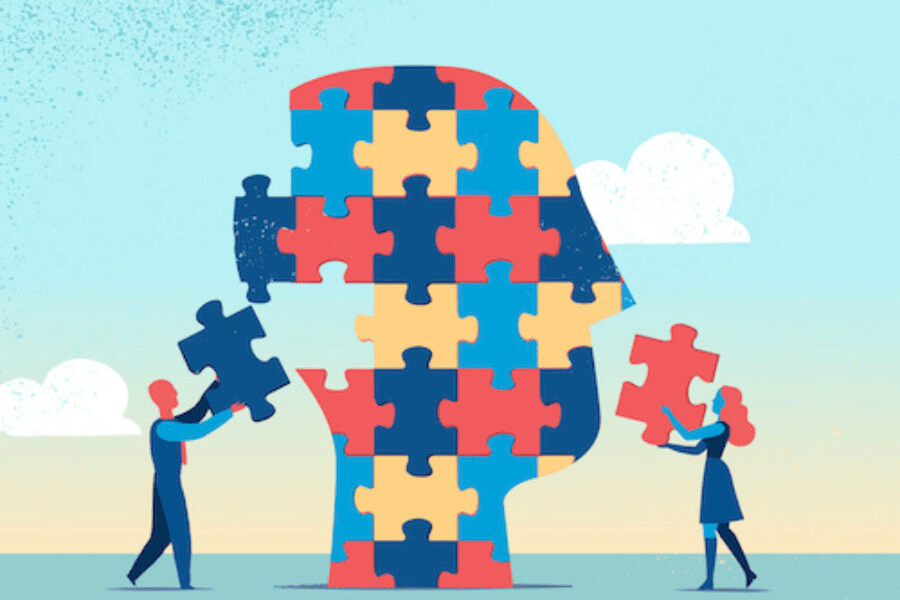
And maybe that is the real beauty. We are not defined by the parts we cannot explain. Instead, we are defined by the meaning we learn to create from them. Every time you step forward, you add a piece to your ever-growing puzzle. It does not matter if you don’t see the full picture yet, because, truth is, life wasn’t made to make sense from the inside.

So if you feel unfinished, good. It means there is space to grow toward a self that feels honest. It means you still have room for new light. It means the story is unfolding and you are awake inside it.

You are allowed to be a work in progress. You are allowed to be a constellation still forming. You are allowed to discover who you are by living, not by knowing.

And that is enough.


Written by Mason Lai, a California high schooler.