



I’m Not (Yet). But My Brain Is Growing Into Adulthood
When was the first time I truly felt like a grown-up?
Honestly? I haven’t. Not fully. I’m a high school senior — standing on the edge of adulthood, but not quite there yet.
What Does It Even Mean to “Feel Like a Grown-Up”?
Is it about knowing exactly what you’re doing?
If so, I’m not sure anyone ever really knows.
Maybe it’s about handling life’s challenges calmly, making decisions confidently, or feeling in control.
But the truth is that our brains aren’t wired to feel “adult” just because we’ve hit a certain age.
The Brain Doesn’t Care About Legal Milestones
Legally, adulthood starts at 18 or 21, depending on where you live.
Culturally, some say adulthood begins at 30. Some say earlier.
But neuroscience tells a much more nuanced story.
The Prefrontal Cortex: Your Brain’s CEO
The prefrontal cortex (PFC) is like the CEO of your brain.
It manages:
- Impulse control
- Emotional regulation
- Long-term planning
- Understanding others’ perspectives
- Managing stress and discomfort
But here’s the thing:
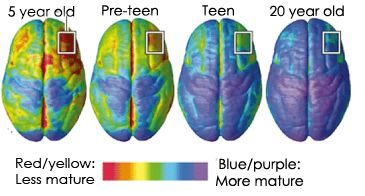
The PFC doesn’t fully mature until your late 20s or even early 30s.
Even more importantly, it’s not just the PFC on its own. We need to factor in how well it communicates with emotional centers like the amygdala that keeps improving well into adulthood (Casey, Tottenham & Liston, 2005).
Why Don’t I Always Feel Like an Adult?
Because feeling like an adult isn’t about your age or your achievements.
It’s about your brain’s wiring and how your mind manages emotions and decisions.
What Happens When You Do?
Neuroscientifically speaking, it’s when your prefrontal cortex takes the lead and calms your amygdala in a process known as top-down regulation.
This means you regulate your own emotional response, which allows you to be fully present and supportive.
Dr. Dan Siegel calls this vertical integration: when higher brain functions sync harmoniously with emotional and physiological systems, creating balance and resilience.
This also ties into the dual-systems theory, which explains the balance between our fast, emotional “hot” brain and slower, thoughtful “cool” brain.
Adulthood Is a Process, Not a Moment
There are no fireworks or instant transformation.
Neurologically, adulting is about:
- Neural integration — brain circuits learning to communicate and cooperate better.
- Flexibility under pressure — choosing thoughtful responses over impulsive reactions.
- Emotional presence — staying grounded even when things get tough.
The Takeaway
I’m not fully grown-up. Maybe you aren’t either.
Sometimes, my brain does act like it’s ready.
And these quiet, uncelebrated moments are proof that adulthood is less a destination and more a gradual, ongoing process.
References
Siegel, D. J. (2012). The Developing Mind: How Relationships and the Brain Interact to Shape Who We Are.
Casey, B. J., Tottenham, N., & Liston, C. (2005). Imaging the developing brain: what have we learned about cognitive development? Trends in Cognitive Sciences, 9(3), 104–110.
 Mason Lai