


Inside Out: The Discipline of Feeling

Daily writing prompt
When are you most happy?

Pixar’s Inside Out is often praised for making emotions legible, by color-coding them, naming them, and placing them neatly at their respective spots at a control panel. While it may be easy to watch the movie and believe its message is the value of emotional mastery, this surface clarity reveals a more unsettling argument. Inside Out attempts instead to reveal the value of emotional tolerance. Its deepest claim is not that happiness comes from managing feelings well, but that constant contradiction of emotion is necessary to create identity.

I. Continuity

Joy begins the film as the keeper of continuity. She treats Riley’s inner life as something to be curated, and protected from contamination. Sadness, in her view, corrodes life. If sadness touches a memory, the memory changes, so Joy fears this potential narrative fracture. However, this fear is prevalent in modern culture. We believe happiness to be stability; we believe it to be a consistent mood, a smooth trajectory. Self-help language also reinforces this fantasy by encouraging us to “protect our peace” as though peace were a fragile artifact rather than a dynamic process. At the beginning of the movie, Joy embodies this impulse, believing that if the right emotions remain in charge, the self will remain intact.

II. Sadness

But Inside Out dismantles this belief. When Sadness touches Riley’s memories, they don’t crack or fracture; rather, they deepen. Riley’s joyful recollections of childhood play become tinged with grief, but not because the joy was false; that grief comes from the memories belonging to a time that cannot be recovered, something we have all experienced. The memory gains depth and complexity, and with that comes narrative truth. What Joy interprets as damage is really just maturation.

The film suggests that unpleasant emotions like sadness are necessary to complete meaning. Only through sadness can experience remain emotionally legible over time. Without it, memories become artifacts, forever frozen, incapable of accommodating change. Riley’s crisis emerges when her emotional system can no longer pretend that continuity is possible. Moving cities disrupt her internal story. Her old sources of meaning, her friends, routines, and landscapes, shift apart. And the attempt to remain cheerful under these conditions produces emotional turmoil.

III. Growing

The ultimate resolution to this crisis is not the restoration of Joy’s authority, but a deeper understanding of the emotional hierarchy. When Sadness is allowed to speak, Riley’s pain becomes shareable. The problem isn’t solved, but her parents can help because the problem has been named.

In this sense, Inside Out offers a corrective view to a culture obsessed with emotional optimization. It suggests that unlike popular belief, psychological health is not achieved by minimizing negative states, but by allowing them to rise up to construct meaning. The film implies that identity is a dynamic system that must remain open to revision.

IV. Conclusion

The film ends with memories that shimmer with multiple emotional hues, refusing closure. Riley’s inner life becomes more difficult to map out, but it becomes more real. Every emotion evolves together. If Inside Out has a lesson, it is not that sadness is good, or that joy is naive. The lesson lies in the fact that a self that insists on feeling only one thing at a time will eventually lose the ability to feel anything honestly at all. Emotional maturity, like narrative truth, requires the courage to let experiences change us. Even if it’s hard. Even if it disrupts the story we carry of ourselves. Because to live is to keep becoming, again and again.
Should We Erase Painful Memories? The Neuroscience Behind Memory Editing

Quick Shot/ Shutterstock
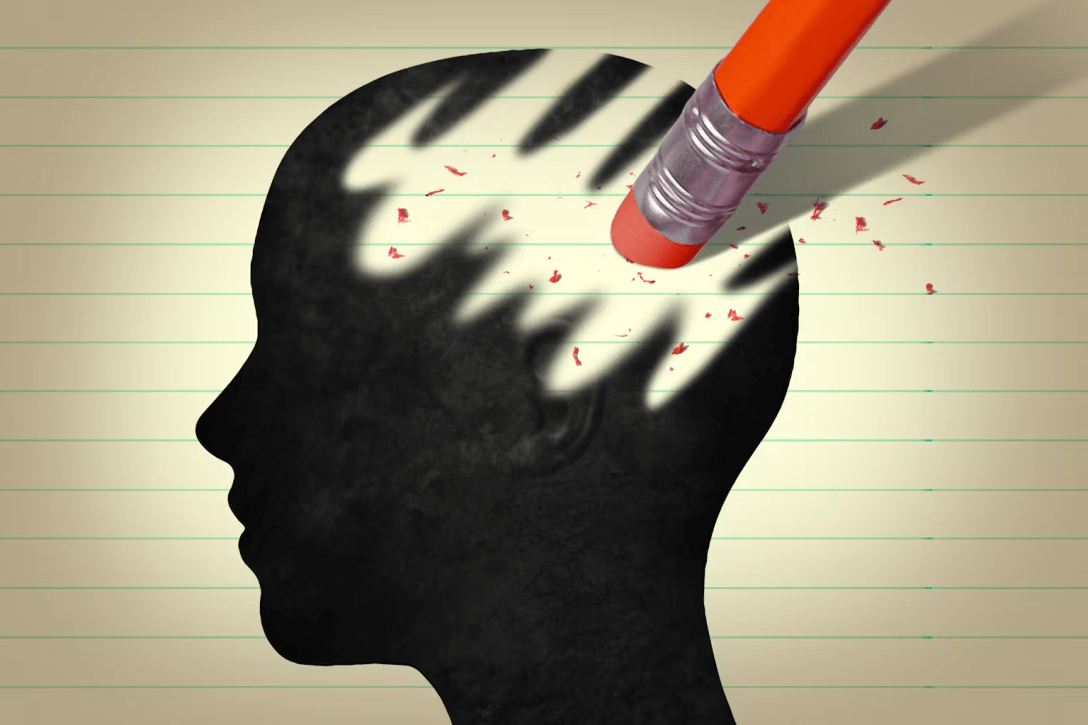
Memory-editing research is advancing fast. But removing our pain may also remove the person we became because of it.

There’s a question that keeps surfacing in neuroscience labs and ethical journals alike:
If we had the power to soften or erase painful memories, should we?

Researchers already know how to disrupt memory reconsolidation, which is the process by which a recalled memory becomes flexible before being stored again. Beta-blockers like propranolol have been shown to dampen the emotional intensity of traumatic recall in PTSD patients. Optogenetics experiments in mice have altered fear memories by re-tagging them with different emotional associations. Even human trials are exploring noninvasive stimulation to interrupt unwanted memories during sleep.

We are, quietly, entering an age where pain is editable.

But the more I read about these findings, the more a different question forms underneath the scientific one. Not Can we edit memory? But What happens to the self if we do?

The Problem with a Pain-Free Self

Memory is a fragile process, forever rewriting itself. Every time we remember something, we alter it slightly. Neuroscientists call this reconsolidation, but even without jargon, most of us know the feeling: a memory that once hurt becomes softer; another becomes sharper for reasons we can’t explain.

This plasticity is what makes memory-editing plausible, but it’s also what makes identity complicated. A life without painful memory might be easier, but would it still be yours?

Where Identity Lives

One of the more haunting ideas in cognitive science is that memory is less about accuracy and more about coherence. Rather than storing experiences like files; we reconstruct them to match who we believe we are now. The philosopher Daniel Dennett once suggested that the self is the “center of narrative gravity”, like a stabilizing illusion that helps us make sense of flux.

If that’s true, altering memory, scarily enough, changes the storyteller as much as the story itself.

A person who erases the memory of a betrayal becomes someone who never had to learn trust again.
A person who erases the memory of failure becomes someone without the quiet resolve that follows.
A person who erases grief becomes someone untouched by the shape love leaves behind.

One thing I continue to wonder is whether the edited self still be continuous with the original, or if the break in memory creates a break in identity too.

The Ethics of “Improvement”

There’s a moral seduction in self-editing. We are obsessed with optimization. Think better bodies, better habits, better productivity, everything in modern life. Why not better memories?

We know how important pain is, though. The fear of loss teaches us to hold people closer, and failure teaches us resilience. Even the most painful moments, those we’d give anything to erase, become part of how we find meaning again.

Neuroscientist Karim Nader, one of the pioneers of reconsolidation research, once said that memory’s primary function, surprisingly, is not to preserve facts, but to help us adapt. By that logic, even painful memories are functional. They help us navigate danger by recognizing patterns.

So when we “improve” ourselves by removing them, we risk becoming someone optimized, perhaps, but hollowed, a self that is easier to carry but harder to recognize.

The Risk of Losing the Lessons Without the Pain

The most compelling counterargument to memory-editing is not that it’s unnatural or reckless. It’s that we might remove the pain without keeping the wisdom.

In one study at NYU, rats whose fear memories were disrupted no longer avoided dangerous cues. They walked into places where they had once been shocked, oblivious to the threat. When we erase hurt, we erase the part of ourselves that learned how to endure.

A Different Kind of Healing

This isn’t an argument against treatment. For example, PTSD is more than just a memory; PTSD is a nervous system in overdrive, a life paused inside an unrelenting moment. In this case, damping the emotional intensity of those memories is more a form of liberation.

The ethical line appears not at the removal of unbearable pain, but at the removal of meaningful pain, a subtle difference.

So, scientific interventions can help us loosen trauma’s grip, but perhaps they should not offer us amnesia.

What We Stand to Lose

Every once in a while, when I think about memory alteration, I imagine a version of myself who never had to rebuild after loss. Someone lighter, less afraid, unburdened.

But that person would not know why loyalty matters, they would not understand the texture of fear or the softness that follows grief, and they would not know the cost of love. They would be me without the evidence that I have lived.

Maybe the Goal Isn’t Erasure

The goal is not to extract a memory as if it were a stain that can be lifted. Perhaps the goal is to reinhabit it in a new way, so that its emotional weight is redistributed and its meaning evolves rather than disappears. To reshape the experience without erasing the fact that it occurred.

Neuroscience may eventually offer the ability to select what we carry forward. Yet meaning is something we craft through engagement, not something we inherit passively or delete at will. The self grows through reinterpretation, revision, and integration, not through subtraction.

So, Is a Life Without Painful Memory Better?

It might be simpler, or lighter, but what makes a life whole is rarely what makes it easy. Pain itself is not the adversary. What harms us is the sense of being imprisoned by it, unable to move beyond its earliest form.

A life without painful memory may shield us from suffering, but one shaped through painful memory gives rise to everything that matters.

Most of us live somewhere between those two possibilities. We carry moments that hurt but keep learning how to carry them differently. In that ongoing process, memory acts as a teacher, and the self becomes something we build rather than something we escape.

That is where the story, no matter how tragic, ends, and growth begins.


Written by Mason Lai, a California high schooler.