

“The real voyage of discovery consists not in seeking new landscapes, but in having new eyes.”
-Marcel Proust (July 10, 1871 – November 18, 1922)
Combining neuroscience and philosophy through the lens of relational dynamics in all the little spaces in between
-Marcel Proust (July 10, 1871 – November 18, 1922)
Pooh: “What day is it?”
Piglet: “Today!”
Pooh: “My favorite day.”
-A. A. Milne (January 18, 1882 – January 31, 1956)

A Personal Meditation on the Overlooked
“It is not enough to be busy. So are the ants. The question is: what are we busy about?”
— Henry David Thoreau, WaldenI’ve been thinking about this a lot lately, how we’re always doing something. Scrolling, replying, running errands, checking notifications, planning the next step in our lives. There are no breaks in the modern way of life. Sometimes even when we try to slow down, our minds are still running at the same speed.
The weird part? Most of the time, I don’t even know what I’m chasing. This feeling is probably universal, right? (unless you’re totally unhinged, in which case… congrats?) Like you’re ticking off boxes, but you’re not sure where that list came from in the first place?
The other night I sat on my porch just for a few minutes with no phone, no agenda. Just sitting. I noticed the wind in the trees, a neighbor’s dog barking, the way the air felt a little cooler than usual. It wasn’t dramatic. No thunderbolt revelations. But I felt present in a such a way that it was almost a miracle.
Moments like those have made me realize that we were never built to be machines.
Yes, working hard has it’s place. But not all the time.
And definitely not at the cost of being alive to your own life.
I’ve made an effort to treat slower days and slower moments as the essential times they are. The little things, those things that give life its flavor (like smiling at someone in the morning, or the way your tea smells, or the color of the sky) are just as much a part of life as the big things we constantly chase.
The slow moments are where you digest the rest of your life.
So next time you’re wondering what to do, consider:
There’s nothing harmful in slowing down.
The answer isn’t always to do more.
Maybe it’s ok to pause.
To breathe.
To do “nothing.”
Because maybe that’s where everything is.
“Music is not in the notes, but in the silence between.”
– Claude Debussy (8/22/1862 – 3/25/1918)
One morning during a quiet surf session, one man stood out from the rest. He had a long, white, Gandalf-esque beard that dripped with seawater. Despite being more than 65 years old, he took waves with a grace that could only be mastered with years of his craft. And from that moment on, he was known to me as the legendary Santa Claus of the Sea.
He was graceful. But this image stands in stark contrast to the current dominant narrative of aging.
Many health professionals are familiar with the list of common aging-related challenges, including:
Alongside these physiological changes, we see a rise in mental health challenges:
These factors compound each other. For example, a loss of balance leads to a fall, which results in injury, which leads to hospitalization, immobility, and sometimes institutionalization, which all accelerate decline.
Modern rehabilitation techniques try to interrupt this cycle, but traditional therapy methods, particularly in geriatric care, often rely on repetitive, low-engagement exercises: resistance bands, parallel bars, leg lifts in clinics. These are essential in many cases, but they’re not enough. My grandma was prescribed chair exercises, but I want her to be able to strengthen herself in practical ways.
Adherence is a chronic challenge. Motivation wanes. And much too often, patients disengage.
So what if we reframed therapy? What if we made it joyful?
Surf therapy is a movement-based, nature-integrated intervention that merges physical rehabilitation with emotional renewal.
It may sound radical, even niche, but it can gain traction for good reason.
All of this takes place in a natural environment that stimulates the senses and evokes meaning: the ocean. The ocean is something that soothes the mind, the beach a bonding place for communities, and the water something that reminds people — especially older adults — that they are still capable and evolving.
Though still an emerging field, several pilot programs and studies are showing promising results — not only for youth and veterans, but also for older adults and people living with chronic conditions.
In this way, movement that is meaningful is more sustainable than movement that is merely prescribed.
“Isn’t surfing dangerous for older adults?”
Yes — and no.
All physical activity carries some level of risk. But so does inactivity.
In fact, sedentarism is one of the most dangerous behaviors for aging adults, associated with:
Most participants start slowly: learning to float, sit on the board, or wade safely. Athleticism isn’t required. Just reconnecting with movement, shedding fear of it, and being open to growing from unfamiliar experiences.
Surf therapy doesn’t replace traditional rehab. It complements it by giving people a reason to get stronger. And even if it’s not surfing specifically, being outside and in the elements is the reward in it of itself.
The big idea is this:
Therapy doesn’t have to feel like therapy.
It can feel like joy. Like renewal. Like living again.
Healthy movement shouldn’t be limited to lifelong athletes. The myth that older adults are fragile, disinterested, or unwilling is just that — a myth.
The Santa Claus of the Sea isn’t just a surfer. He’s a living contradiction to our ageist expectations.
So understanding that movement if life at any age, we must devise better plans for maintaining movement in seniors. And we can start by inviting more of our elders into the water.
Do you find yourself unable to focus on things that matter?
Tasks that you know, without a doubt, will benefit your life. Things you’ve promised yourself you’d do, goals that could reshape your future… Yet, somehow, you don’t do them.
I do.
And I’ve tried to understand why.
I’ve dipped into the science of focus, from the neurological mechanisms that help us stay on task to the conditions needed for deep, uninterrupted work. But the deeper I dig, the more confused I become. The research contains contradictions, and what the media says about focus rarely aligns with what actual cognitive scientists are discovering.
And with the rise of self-improvement culture, a mythology has formed around the idea of discipline. We’re told that successful people are just more focused, more motivated, more driven. And if we’re not like them, the implication is that we’re simply not trying hard enough.
But that’s as far from the truth as you can get.
I’m not an expert (though I’d like to become one), but here’s the clearest conclusion I’ve come to:
The problem isn’t a lack of effort. It’s a lack of systems.
It’s not that you’re unwilling to do the work that needs to be done. It’s just that your environment, your habits, and the mental scaffolding you’ve built around your day-to-day life aren’t optimized to support focus.
Everything in nature requires activation energy (hi, chemistry class)—a certain threshold that must be met before a reaction can occur. The same applies to our behavior. Starting something hard, like studying, exercising, or writing, takes far more energy than continuing once you’ve begun. That beginning stage is the hardest part. And modern life is constantly raising the cost of starting.
Unfortunately, every time we reach for our phones, scroll social media, or binge a few episodes of something “harmless,” we’re not just wasting time, we’re retraining our brains (and I, more than anyone, wish this wasn’t true). We’re conditioning it to seek high-reward, low-effort stimulation. And the more we feed it, the more it resists anything else.
And that’s what’s scary. We think that these things are just distractions, but those early hits of false stimuli are actually inoculations that blunt our ability to focus later. They raise our brain’s threshold for engagement. So when we finally try to sit down and do the important stuff (stuff that takes time, patience, and effort) our mind rejects it. Not because we’re lazy, not because we’re unmotivated, but because we’ve already taught our brain what to crave.
Small actions have big outcomes. That innocent scroll in the morning may seem like nothing, but it creates ripples throughout your entire day. By the afternoon, your ability to focus has been quietly, but significantly, eroded. And no amount of “trying harder” can change that, because by then, the system is already working against you.
I can start with the biggest lie I’ve ever been told.
“It’s not that simple.”
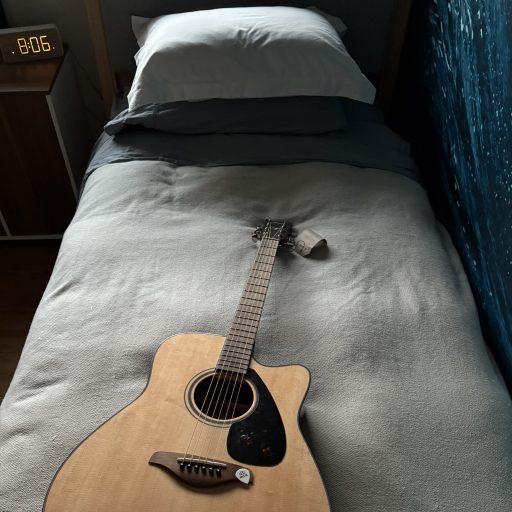
I believed it. Whenever I told my peers I wanted to start something new – do better in class, start writing poetry, pick up boxing, start learning guitar – the one phrase that always cut through was:
“It’s not that simple.”
But today, I want to tell you something different.
The best piece of advice I have ever received is this:
It’s always that simple.
I love to overcomplicate things. I bet you do, too. We create mental barriers as excuses to validate our inability to accomplish our goals. We tell ourselves that it’s complicated, our timing’s off, or we’re not ready. But in reality, they’re excuses disguised as logic. Sometimes, we even adapt to our inability to adapt, and in doing so, we stay stuck in places we don’t want to be.
But being stuck is not a failure. It’s a starting point. And you can choose where you want to go from there.
Because it really is that simple.
Yes, doing things you’re not used to is scary. Heck, it scares me, and it probably scares everyone.
The consistent discipline it takes to accomplish your greatest desires, to ascend, to have the authority to dream big – that’s difficult. But when it comes down to knowing what needs to be done, your brain will always know.
The first step, the next step, the final step – it’s all one, and it’s always within you.
You don’t need a hundred tutorials. You don’t need motivational videos on loop. You don’t need anyone to give you permission.
Everything you need is already there.
Yes, it’s going to be hard, and you’ll have to give more than you’ve ever given before.
But just remember:
It’s still that simple.
And that’s what makes it possible.


 Mason Lai